
Cancellation of the sediment diversion initiative occurred in July 2025.9 billion Mid-Barataria Sediment Diversion project in July 2025 has prompted a re-examination of how large-scale infrastructure projects navigate the complex intersection of environmental science, political pressure, and community interests. The National Marine Fisheries Service notes that project failure threatens restoration across 44432 square miles of habitat. This warning appears in the Civil Engineering Source by the American Society of Civil Engineers.
Diversion of Mississippi River sediment into the 5 million-acre Barataria Basin was the project’s goal. This 20-unit estuary system sits south of New Orleans. This basin is 120 miles long, 24 to 35 miles wide, and 3 feet deep. Since 1932, a total of 432 square miles of territory has been lost within the area. Projections indicate that 1,110 to 3,000 square miles of territory might disappear within 50 years. Such loss would result in damages totaling $15 billion. In 2017, the state legislature authorized a plan to move 7 sediment-heavy flows of 75,000 cubic feet per second into the basin. It featured an 800-foot-long structure meant to build 6,260 to 17,300 acres of land by 2050, using 17 percent of available sediment. Despite backing from the Louisiana Coastal Protection and Restoration Authority and support from 80% of residents, costs surpassed $600 million. Planning began in the 1980s, influenced by a 2010 oil spill that fouled 1,300 miles of coastline, including 300 miles in Louisiana and 10 miles of wetlands. The 2023 Coastal Master Plan remains a key reference. Concerns regarding the potential harm to commercial fishing, oyster habitats, and local bottlenose dolphin populations fueled legal challenges that ultimately stalled the work.
Industry experts note that the technical foundation of the project was subject to extensive scrutiny. While supporters of the project maintain that the science was sound and vetted globally, critics questioned the accuracy of environmental modeling. Some researchers argued that empirical data from previous river diversion efforts did not support the project’s projected land-building benefits. This disconnect between modeling and public perception persists. This situation mirrors the 2000s, when plans to relocate 2,500 to 15,000 cubic feet of sediment stalled. In early April 2025, Governor Jeff Landry mandated a 90-day hiatus for that work.
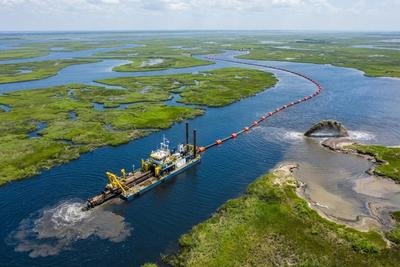
Following the cancellation, stakeholders are debating alternative strategies. The state is now pivoting toward smaller, less disruptive interventions, such as dredging and a proposed sand engine concept. These alternatives aim to address land loss without the severe salinity fluctuations that would have been caused by larger river diversions. However, experts warn that dredging is costly and lacks the long-term sustainability that a continuous sediment diversion might have provided.
For insurance and engineering professionals, the case highlights the necessity of robust governance frameworks for infrastructure development. Experts suggest that future projects must prioritize structural insulation for independent reviewers and ensure transparent communication regarding funding and methodology. Since the Mid-Barataria diversion project was first proposed in 1984, stakeholders have realized that technical merit is not enough. Success requires navigating complex social and political hurdles in regional planning.
Image is an illustration created with AI for general context










