The Associated General Contractors of America is expanding its Certificate of Management-Building Information Modeling program beyond domestic borders. The initiative recently reached Qatar to support national infrastructure goals tied to the 2022 FIFA World Cup. This development signals a shift in how the organization delivers professional construction education on a global scale.
The expansion into Qatar was spurred by government mandates requiring specific construction credentials for workers. Following a 2018 collaboration, the program now partners with the Ministry of Public Works, called Ashghal, to train professionals on large-scale infrastructure. While BIM adoption in the U.S. is often driven by individual firms, the Qatari market requires these skills to satisfy federal project requirements.
Instructors have noted that international participants often bring diverse backgrounds, ranging from experienced managers to those new to digital modeling. The curriculum establishes a baseline for how project data moves through the entire building life cycle. By emphasizing data hand-over protocols and asset management, the training aims to help government and private entities maintain complex structures long after construction ends.
To accommodate evolving industry standards, the association is launching the 4th Edition of its curriculum. This update incorporates new technologies such as artificial intelligence, drones, and digital twins. The transition marks a move away from lecture-heavy, legalistic content toward a model that emphasizes group engagement and practical problem-solving in virtual environments.
Warren Kiesel, the organization’s director of curriculum development, stated that the latest edition is designed to function as a practical playbook. The objective is to transition participants from understanding theoretical concepts to applying them as part of an organizational business strategy. Drawing on the last 10 to 15 years of industry site experience, the program helps contractors achieve predictable outcomes and better operational efficiency.
For insurance professionals and risk managers, these developments represent a shift in project delivery methodologies. Standardized training in virtual design and construction can lead to better risk mitigation, as teams identify coordination issues during the modeling phase rather than on the jobsite. Assessing how contractors utilize these digital frameworks is increasingly relevant when evaluating project performance and liability exposure in complex infrastructure ventures.
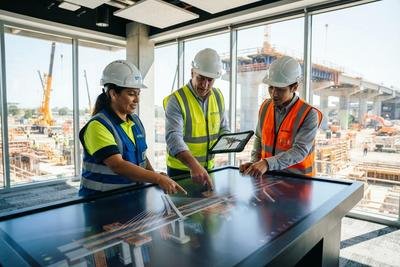
Image is an illustration created with AI for general context