
The American Society of Civil Engineers is pushing for immediate progress on the Water Resources Development Act of 2026, alongside reauthorization for surface transportation. According to ASCE2027, these bills ensure funding stability. Every state will receive at least $75 million annually for infrastructure maintenance. This continues the WRDA cycle established in 2014, which had its most recent passage in 2024. Professionals anticipated movement on these bills this summer. However, the current legislative climate has created uncertainty as lawmakers approach upcoming recess periods.
Legislators passed a short-term extension signed by President Trump on Sept. 30, following a process that took 3 months. 2, keeping existing programs operational until Dec. 11. This stopgap measure, similar to funding gaps observed between 2014 and 2024, excludes advance appropriations. It leaves 1 transit sector concern: reduced support for highways and rail systems. Industry professionals warn that the absence of a long-term reauthorization bill creates significant planning complications. Delays in funding can result in stalled projects, safety concerns, and substantial cost overruns for local and state governments.
Legislation concerning water resources has also faced hurdles. Although the Water Resources Development Act passed the House of Representatives on Sept. Following the Nov. 9 committee action, the bill awaits a full Senate vote. Getting 60 votes for this provision will be difficult. ASCE members are focused on a backlog of projects, referencing the 15 and 5 specific policy recommendations.S. Army Corps of Engineers, valued at $100 billion. The Society, which backed the 2023 rule, cites the 1993 gas tax freeze as a concern.S. The backlog overseen by the Army Corps of Engineers totals $100 billion, though the EPA says repealing the rule would save $310 billion. The measure revises the grant formula for the State Assistance program under the National Dam Safety Program. It also reauthorizes the Rehabilitation of High Hazard Potential Dams Grant Program via FEMA.
Regarding surface transportation, the proposed BUILD America 250 Act seeks to provide funding levels consistent with the IIJA, adjusted for inflation. This proposal adds federal fees on plug-in hybrids and EVs for the Highway Trust Fund. It also mandates that 20% of state funding supports off-system bridges. Under the draft bill, owners of hybrid models would face a $35 annual fee, while EV owners would pay $130. The proposal also includes a consolidated $9.This $9.2 billion bridge program allocates funding by calculating deck area and bridge volume according to data from the National Bridge Inventory for structures labeled as being in poor condition.
Legislative delays complicate infrastructure development and risk assessment for insurers, a concern highlighted on 08 September 2026 regarding federal flood risk standards for project-based coverage. Uncertainty regarding federal support structures can complicate the underwriting landscape for large-scale capital projects and public-private partnerships.
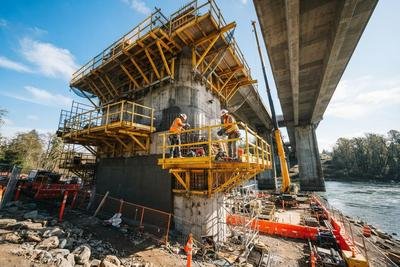
Image is an illustration created with AI for general context










