
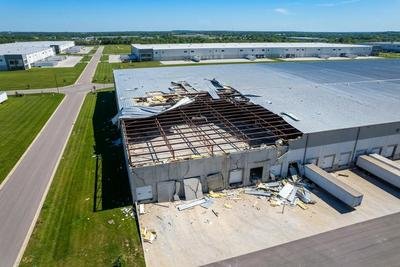
Following the May 7, 2024, EF2 tornado in Portage, Michigan, an ASCE/Structural Engineering Institute team assessed warehouse vulnerabilities using criteria from the 2022 edition of the ASCE/SEI 7 Standard. The storm produced 111 to 135 mph winds, causing major structural damage at a local FedEx site. The building lost much of its roof, and precast concrete wall panels buckled inward. While 40 employees successfully sheltered in restrooms during the event, the incident has sparked a re-evaluation of how large industrial structures are engineered to handle extreme wind events.
According to the report, “Portage, Michigan, Tornado of May 7, 2024, Post-Disaster Assessment,” the facility was not explicitly designed to resist tornado forces. Investigators Franklin T. Lombardo and Donald R. Scott highlighted a “worst-case scenario” involving simultaneous internal and external wind pressures that caused the roof to detach from the walls. The failure was exacerbated by roll-up doors that allowed wind to enter the structure, creating an internal ballooning effect that compromised the building’s stability.
The findings highlight a misalignment between real-world usage and current building codes. Although the facility adhered to the 2015 International Building Code, it was classified as an “enclosed” structure. Experts noted that even when doors remain closed, leakage around large overhead openings can pressurize a warehouse. The report, identified by code 9780784487068, suggests that large buildings previously meeting the 115 International Building Code criteria should be reclassified as partially enclosed to improve safety in tornado-prone zones. Experts urged including specific tornado loading provisions instead of straight-line wind metrics. These include vertical lift and suction pressures, as noted in data from 2026 record 1927594.
The assessment also points to a need for better post-event data collection, noting that existing instrumentation often fails to capture peak speeds due to programming limitations. Insurers and structural engineers should note the delay in building code updates. Changes may not reach the International Building Code until 2030, leaving large modern warehouses in Michigan and Illinois under-protected against shifting climate risks.
Image is an illustration created with AI for general context










