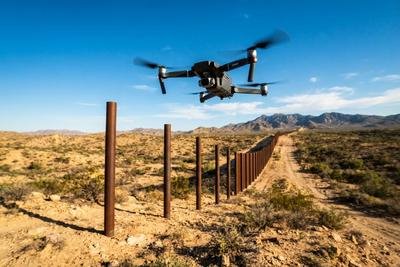
Federal authorities have announced a coordinated initiative to enhance airspace security along the Sean P. Duffy, the Sean P. Duffy, the U.S. Transportation Secretary, said this restriction protects domestic airspace against threats like cartel drones.S. Transportation Secretary, remarked on the necessity of shielding domestic skies.S.-Mexico border. Along with the Department of Homeland Security (DHS) and the Department of War (DoW), the DOT issued this directive.S. Department of Transportation (DOT) issued the guidance.S. Department of Transportation (DOT), the Department of War (DoW), and the Department of Homeland Security (DHS), a temporary flight restriction (TFR) is now in effect for drones.
Operators cannot fly drones across the border zone if they are within a one nautical mile radius of the boundary line. The rule covers altitudes starting at the ground and reaching an elevation of 400 feet. Officials stated that the move aims to mitigate risks to federal operations, protect personnel and facilities, and improve enforcement against prohibited aerial activity.
U.S. Transportation Secretary Sean P. Duffy noted that the restriction serves to protect domestic airspace from illicit activities, including cartel drone threats. Secretary of War Pete Hegseth noted that commanders now have better defense options and situational awareness. He stated, “The United States government will maintain 100% operational control of our border: land, air, and sea,” while confirming personnel use Directed Energy Weapons.
Markwayne Mullin, the Secretary of Homeland Security, stated that the policy reinforces current initiatives aimed at bolstering border protection and mitigating aerial threats. The Federal Aviation Administration (FAA) is tasked with publishing a Notice to Air Missions (NOTAM) to formalize the changes.
This NOTAM will provide specific guidance through the Domestic Notice and the agency’s UAS Data Delivery System. The government has reminded all drone operators that they are responsible for reviewing active restrictions before conducting flights. Operators must ensure their planned activities fully comply with these new regulatory requirements.
For insurance professionals and risk managers, this development signals a shift in the regulatory landscape for aerial operations near the southern border. Policies covering unmanned aircraft systems may require closer scrutiny regarding flight path planning and compliance with federal airspace designations to avoid potential liability for unauthorized incursions into restricted zones.
Image is an illustration created with AI for general context
Source: U.S. Department of Transportation, Department of War, and Department of Homeland Security